
AI
Presence Isn’t Oversight: What the EU AI Act, Article 14, Really Demands of Human-AI Systems
Part 2 of 4 | Hybrid Agentic AI Series by Conor O’Neill
Today’s contact centers still rely heavily on human involvement somewhere in the workflow, whether that is an advisor confirming an AI-suggested response before it’s sent, an escalation path for the complex call an AI bot can’t handle, or an advisor manually reviewing an AI’s summary before it’s saved to the account record.
For years, “human-in-the-loop” or HITL has been the mode of operation for customer-facing service centers. That informal arrangement is about to face a different kind of scrutiny: a growing body of laws and regulations that don’t just expect a human somewhere in the process, but define, in specific and enforceable terms, what that human’s involvement actually has to look like.
The EU AI Act is the first comprehensive AI regulation of its kind, and its obligations for high-risk AI systems (defined through the classification rules in Article 6 and enumerated in Annex III) were originally set to apply from August 2, 2026. Following the EU’s “Digital Omnibus” agreement finalized in June 2026, that deadline has been pushed to December 2, 2027, giving businesses more runway, not more reason to assume the work can wait.
Article 14 of the Act addresses “human oversight” for high-risk AI deployments, and it’s a narrower, harder requirement than most compliance teams currently assume. It doesn’t ask whether a human is nearby or available to review a decision after the fact. It asks whether that human, in real time, can actually understand, monitor, interpret, and override the system’s output. This blog explores what that standard actually demands, and looks at how it echoes human-oversight obligations already embedded in GDPR, U.S. lending law, state AI statutes, and sector-specific guidance.
By now, most businesses know the deadline moved. Fewer have asked whether their oversight model would have survived scrutiny even if the original date had stayed in place. Consider:
An escalation path exists but was designed to manage volume, not risk.
A supervisor can see the queue but can’t meaningfully intervene in a live decision.
Oversight was documented once during a vendor review, but never operationalized.
Bear in mind that this isn’t only a European compliance question: any U.S. company with EU customers, or AI systems whose output touches EU residents, can fall within the Act’s scope. Separately, and irrespective of whether a business has any EU exposure at all, a growing number of U.S. companies are using the EU AI Act as a reference point for their own AI governance, treating it as the most detailed rulebook available while U.S. federal and state frameworks are still taking shape.
What Article 14 of the EU AI Act Actually Requires
Article 14 is built around a simple premise: in a high-risk situation, a human can only “oversee” an AI system if they’re actually equipped to do so. The statute spells out what that equipping looks like. It sets out five specific requirements, found in Article 14(4)(a) through (e), which can be summarized as:
- Understanding is Key. The overseeing person needs to properly understand the AI system’s relevant capacities and limitations, and be able to monitor its operation well enough to catch anomalies, dysfunctions, and unexpected performance. You can’t oversee what you don’t understand.
- The Risk of Over-trust. The overseer has to remain aware of the tendency to automatically rely, or over-rely, on the AI’s output, particularly when the system is producing information or recommendations for a decision a person will ultimately make. In contact centers, this shows up constantly: a bot suggests a resolution, and a human-in-the-loop clicks “approve” out of habit rather than genuine review. Article 14 requires that awareness to be actively built and maintained, not assumed to exist because a human is technically in the workflow.
- The Importance of Interpretation. The overseer must be able to correctly interpret the AI system’s output, taking into account whatever interpretation tools and methods are available. A confidence score or a flagged intent means nothing if the person looking at it doesn’t know what it represents or how reliable it tends to be. Article 14 makes that interpretive competence a legal requirement, not a nice-to-have.
- The Power of Oversight. The human overseer must be able to decide, in any particular situation, not to use the AI system, or to otherwise disregard, override, or reverse its output. Crucially, this is a case-by-case power, not a general policy switch — it has to be exercisable in the moment, on the specific interaction in front of the person, not just as a broad rule set at the system level.
- Pulling the Brakes. Finally, Article 14 requires the ability to actually stop the AI system, not just decline its output. The statute describes this as intervening in or interrupting the system through a “stop” button or similar procedure that brings it to a halt in a safe state. It requires a genuine mechanism to pause or shut the system down entirely, rather than being limited to overriding one decision at a time while the AI keeps running underneath.
These five requirements move human oversight from a vague organizational value into a specific, testable capability: understand it, resist over-trusting it, interpret it correctly, override it case by case, and be able to stop it cold. That’s the bar contact centers will be measured against, and it’s considerably more demanding than “a supervisor is available if something goes wrong.”
Article 14 isn’t the only place EU law asks this question. GDPR’s Article 22 got there first. It gives individuals the right not to be subject to a decision based solely on automated processing when that decision carries legal or similarly significant effects. And where such automated decisions are allowed, it requires that the person can still get human intervention, voice their perspective, and contest the outcome.
GDPR’s Article 22 is a right the individual has to invoke, typically after the fact whereas Article 14 of the EU AI Act doesn’t wait for a complaint. It requires the oversight capability to be built into the system and exercised in real time, whether or not anyone ever asks for it. Together, the two provisions make a useful point: “human oversight” in EU law isn’t a single bar to clear, it’s a spectrum running from a contestable outcome to a controllable process. Article 14 sits at the demanding end of it.
Three Modes of Human Involvement to Meet the Requirements of Article 14
Contact centers deploying AI generally land on some combination of three modes for how a human actually shows up in the workflow. Read together, they’re what it takes to satisfy all five of Article 14’s requirements, not just the override piece.
- Mode 1. Full takeover. The AI handles the interaction until something trips a threshold e.g. a frustrated customer, a low-confidence response, a compliance flag, a sensitive topic, at which point a human advisor takes over the conversation completely. It’s straightforward, and it works. It also cleanly satisfies Article 14’s override and intervention requirements under 14(4)(d): the human isn’t editing a suggestion, they’re fully in control of what happens next.
- Mode 2. Supervisory review. A human can monitor, review, approve, or edit an AI response without stepping into the conversation directly, then hand it back to the AI to close out. Full takeover is still available; it just isn’t the only option. The AI keeps doing the work, and human judgment gets exercised at the point of output rather than by displacing the AI entirely. Done well, this is where the ongoing monitoring and interpretation Article 14 demands under 14(4)(a) and (c) actually live: catching an error, correcting a tone, blocking an answer, or holding a sensitive recommendation for review before it reaches the customer.
- Mode 3. System-level halt. Neither full takeover nor supervisory review, on its own, gives a human the ability to stop the AI system itself. Article 14(4)(e) asks for something separate: a “stop” button or similar procedure that lets the system come to a halt in a safe state, independent of what’s happening in any single conversation. This is the mode most often missing from contact center design, because it isn’t triggered by a single bad interaction. It’s triggered by a broader signal (a spike in overrides, a drift in confidence scores, a pattern of complaints) that says the AI shouldn’t keep operating at all until someone looks at it. Without this mode, an organization can be excellent at handling individual bad outputs and still have no way to shut the system down if something is systemically wrong.
Together, these three modes cover what Article 14 actually asks for: the ability to act on a single interaction (modes 1 and 2), the ongoing monitoring and interpretation that makes that action meaningful (mode 2), and the ability to pull the AI out of operation entirely when the problem is bigger than any one conversation (mode 3). A contact center that has only built modes 1 and 2 has solved the easier two-thirds of the requirement.
This is the platform that ServisBOT has built. AI handles the volume of routine interactions while human oversight is reserved for the moments that actually carry risk. This is layered in as structured, risk-based supervision rather than bolted on as a separate compliance step, with system-level controls sitting above individual interactions rather than being reconstructed after the fact.
Human + AI Oversight: Built In, Not Bolted On
Article 14 of the EU AI Act and GDPR Article 22 are both EU law, but the underlying expectation that human oversight has to be a demonstrable capability isn’t confined to Europe. A parallel set of US frameworks is converging on the same idea. Some of these are state-level (e.g.Colorado’s AI Act that is due to be effective January 2027) , others industry-specific. In financial services, for example, model risk management guidance from the Federal Reserve and OCC (SR 11-7) has for over a decade required banks to maintain the ability to monitor, validate, and override model-driven decisions. This human-oversight standard predates the AI Act by years and is now being extended to AI and ML models specifically.
Mortgage servicing in the US is unusually explicit in its accountability structure. Freddie Mac Bulletin 2025-16, effective March 3, 2026, establishes a clear governance framework for how AI is used in mortgage lending and servicing. While the accountability sits on the shoulders of servicers, a significant portion of what that accountability requires lives inside the AI products, platforms and tools that servicers didn’t build nor control. The bulletin is also clear that automated doesn’t mean unaccountable. There must be a documented, functional path for human review and override of AI-driven outputs. This is a product design requirement, not a policy you can draft around a tool that was never built to support it. If the override capability isn’t in the product, no amount of internal procedure closes that gap.
While the shift to the three modes of human involvement are necessitated by legal and regulatory frameworks, oversight can often fail in practice. Each failure mode is really just one of the three modes, done wrong or never finished:
- Full takeover, built for volume instead of risk. An escalation path exists but was designed to manage volume, not risk oversight. This is Mode 1 satisfying the business need(routing calls efficiently) without satisfying Article 14. A queue that moves fast isn’t the same as a queue that hands the human enough context to actually understand and interpret what the AI did before they take over.
- Supervisory review without real authority. A supervisor can see the queue but can’t meaningfully intervene in a live decision. This is Mode 2 present in name only. Visibility isn’t authority. Article 14 requires the ability to act, in the moment, on the specific interaction. If the supervisor can watch but not override, the oversight is cosmetic.
- System-level halt that was never built. Oversight was documented once during a vendor review but never operationalized. This is Mode 3 missing entirely. A written policy isn’t a stop button. If no one can point to how the AI system itself gets pulled out of operation when something goes systemically wrong, Article 14 hasn’t been met — no matter how thorough the paperwork looks.
That’s the real thread connecting Article 14, GDPR, and Freddie Mac’s bulletin: the law on both sides of the Atlantic, at both federal and state levels increasingly assumes oversight is a capability. A servicer can write the strongest AI governance policy in the industry, but if the AI-powered chatbot, servicing copilot, or fraud detection tool it relies on wasn’t built with real intervention, interpretation, and halt capability, that policy has nothing to stand on.
This is precisely why ServisBOT has built all three modes into the product architecture itself rather than treating them as a checklist a servicer has to reconstruct after the fact.
The organizations that will be ready, whether the deadline in front of them is Article 14’s December 2027 date, Freddie Mac’s March 2026 date, Colorado’s January 2027 date, or the next regulation to land on this same idea, are the ones that stopped treating human oversight as something to prove and started treating it as something to build.
This won’t be the last word on Article 14, or on what good oversight looks like in practice. As more contact centers work through this transition, the real lessons are still being written. We’ll keep tracking it.
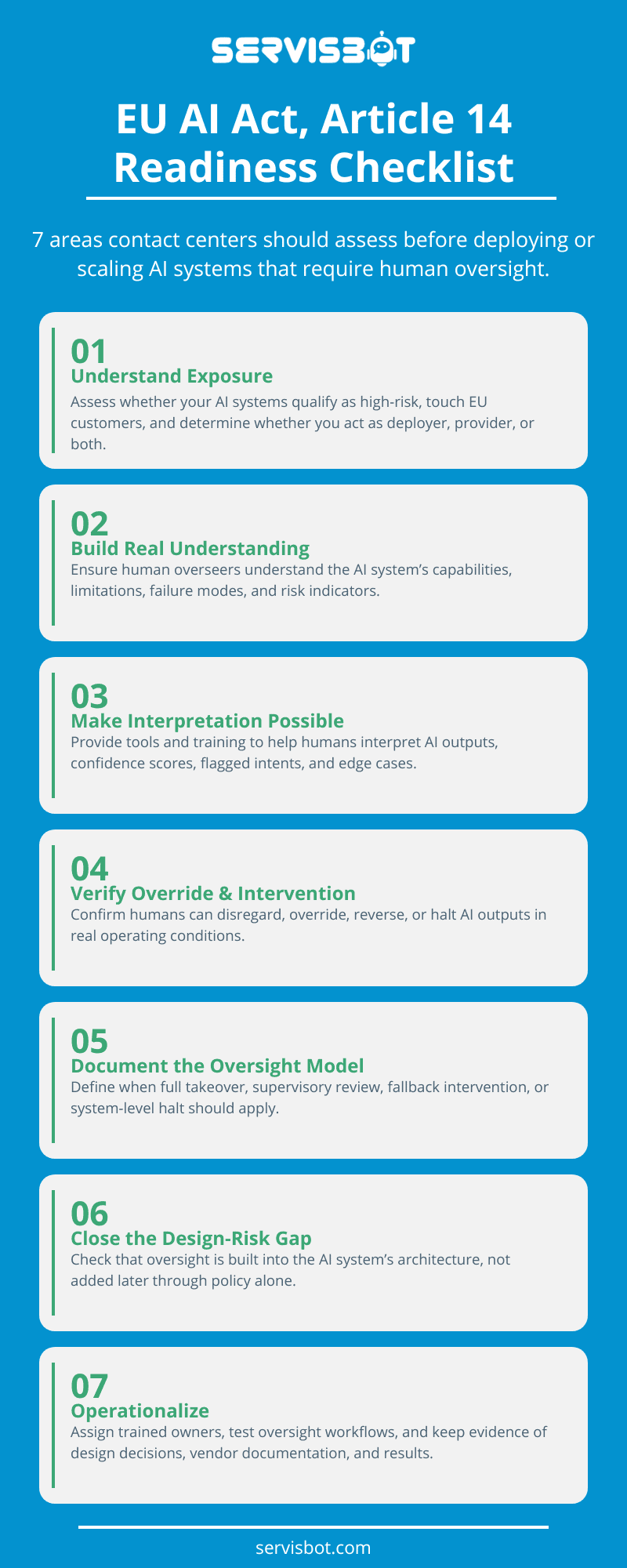
A Readiness Checklist for EU AI Act, Article 14
To help businesses assess their readiness for EU AI Act Article 14, we’ve created a practical checklist covering seven areas contact centers should consider when deploying AI systems that require meaningful human oversight (below is a mini version).
If you missed part 1 in the series, check it out here.
Next in this series: How a hybrid agentic AI model actually delivers on human oversight in practice, not just in principle, from how risk gets scored to how a single supervisor’s decisions make the system smarter over time.