
Agentic, AI
The Hybrid Agentic AI Model: How Human and AI Collaboration Is Changing the Way Regulated Businesses Deploy AI
Part 1 of 4 | Hybrid Agentic AI Series by Conor O’Neill
Every business leader we talk to is up against the same reality right now – they know AI can handle more, they’ve seen the demos, and they understand the benefits of AI efficiency. They also feel the competitive pressure knowing industry peers are moving. They also know that the architecture of how you deploy AI matters as much as the decision to deploy it at all, and in regulated industries, getting that architecture wrong carries consequences that are operational, regulatory, and reputational. New legislation, like the EU AI Act is raising the bar on how AI must be designed, governed, and overseen, making the architecture decisions more strategic than ever.
The question every organization has to answer is what happens when AI gets it wrong, and in a regulated environment, getting it wrong carries real consequences. AI influencing a credit decision in a way that is not just bad practice but legally prohibited, with no audit trail showing why the AI did what it did or whether a human ever had the opportunity to intervene. A fee waiver applied when policy and regulation prohibit it, or denied when a human with context would have approved it. A vulnerable customer receiving a response without the empathy or compassion the moment required.
When AI gets it wrong in a regulated environment, the cost is rarely just operational. It can mean a regulatory action, a brand-damaging news cycle, and reputational damage that takes years to recover from.
The All-or-Nothing Problem with Agentic AI
Agentic AI, by definition, is autonomous, meaning AI makes decisions and takes actions without human involvement. That capability is what makes it powerful, and also what makes the architecture question so important in regulated environments. When organizations deploy agentic AI today, they usually find themselves at one of two extremes.
The first extreme is full automation. The AI safely handles low risk scenarios end to end, things like cancellations of auto-renewals, account updates, or emailing a copy of an invoice. It is scalable, improves contact center efficiency, and lowers the cost of service. But as we know, not every interaction is straightforward or routine. Customer sentiment, conversation complexity, and regulatory or risk signals can change the nature of an interaction quickly, and even with guardrails, today’s agentic AI systems most often have no mechanism for recognizing when they have moved beyond what they should be handling on their own – and this is where the risk lives.
The second extreme is manual oversight, sometimes called human in the loop. When an interaction moves outside the guardrails of defined scope, the system immediately defaults to bringing a human into the conversation to intervene and bring it to resolution, often undermining the efficiency potential of AI. Humans become the fallback for everything the AI cannot confidently handle, queues build, and the ROI case is weakened.
Neither extreme is usually the answer. For businesses that want the efficiency benefits of AI without the exposure that comes with full automation, there is a better model. That model is hybrid agentic AI.
What Hybrid Agentic AI Looks Like in Practice
The reason most organizations end up at one of those two extremes is not due to a lack of ambition or investment. The truth is that deploying agentic AI safely in a regulated environment is genuinely hard. The interactions that carry the most risk are often the ones that start out looking routine, a straightforward payment inquiry that reveals a hardship, a simple account update that uncovers a customer in distress, or a question that begins straightforward and quickly becomes more complex. Building a system that can recognize those moments in real time and respond appropriately requires a different kind of architecture than most contact centers have invested in today.
Hybrid agentic AI is a model that bridges those two extremes. At its core, it combines the autonomy and efficiency of agentic AI with structured human oversight and collaboration at moments that matter most, creating a system where AI and humans each operate within their strengths by design.
Rethinking where human judgment lives in the conversation workflow, and building your workflow around that is what separates a well designed agentic AI deployment from one that carries unnecessary risk. A hybrid agentic AI model works on a simple but powerful principle: automate where it is safe, and bring humans in at the decision points that matter most. Those moments are most often the ones with regulatory implications, emotional or sentiment signals, significant complexity, or meaningful financial consequence.
In practice, this means every response generated by an AI agent is evaluated using a scoring engine that looks at the full picture, regulatory exposure, customer sentiment, the nature of the request, and the complexity of the situation, not just a simple rule-based keyword analysis. Interactions that score as low risk are resolved automatically and autonomously by the AI agent and those that don’t are routed to a human supervisor with full conversation context, relevant account information and history and the ability to approve, edit, escalate, or reject before a response ever reaches the customer. A single human supervisor can oversee multiple AI agent led conversations simultaneously, stepping in only where their judgment is genuinely required. And critically, every decision, whether made by the AI or a human is documented, explainable, and auditable.
Done right, this model delivers the efficiencies and scalability of agentic AI, with the human oversight and control that regulated environments demand.
Why This Matters More Now Than It Did a Year Ago
Leveraging a hybrid agentic model gives organizations a practical path to deploying agentic AI confidently, at their own pace, and at scale. For regulated businesses, that path is becoming more important to get right as the compliance landscape around AI continues to shift. The EU AI Act was published in July 2024 and its requirements for high-risk AI systems become enforceable on August 2, 2026, weeks from now. Among those requirements, Article 14 speaks directly to how human oversight must be built into high-risk AI systems by design. And while the US does not yet have a federal AI governance framework, states are increasingly moving to establish their own standards. Unlike the EU, where there is a single framework to navigate, the US is headed toward an overlapping web of state-by-state requirements that will only add complexity for regulated businesses operating across state lines.
The consequences of non-compliance are significant. According to Secure Privacy’s 2026 EU AI Act compliance analysis, penalties for failing to meet high-risk obligations can reach €15 million or 3% of total worldwide annual turnover, and regulators have the authority to order non-compliant systems withdrawn from the market entirely until compliance is demonstrated.
For US-based regulated businesses, the EU AI Act’s August deadline may not carry the same immediate weight. However, Holland & Knight, one of the top 15 largest law firms in the United States, has made clear that US companies operating high-risk AI systems may be required to follow compliance measures if they operate or serve customers in European markets. And for those without direct European exposure, the Harvard Data Science Review has observed that organizations developing or deploying AI in cross-border contexts would do well to treat the EU AI Act as a valuable compliance scaffold, given that its structured approach to human oversight, data governance, and post-deployment monitoring aligns closely with where American regulatory expectations are heading.
5 Questions Every Business Should Be Asking About Their AI Right Now
Whether you are building internally, working with a vendor, or using a hybrid of both, and whether you are at the planning stage or assessing AI already in production, these questions are designed to help you evaluate if human oversight has been genuinely considered as part of your AI architecture from the ground up, versus a simple add-on.
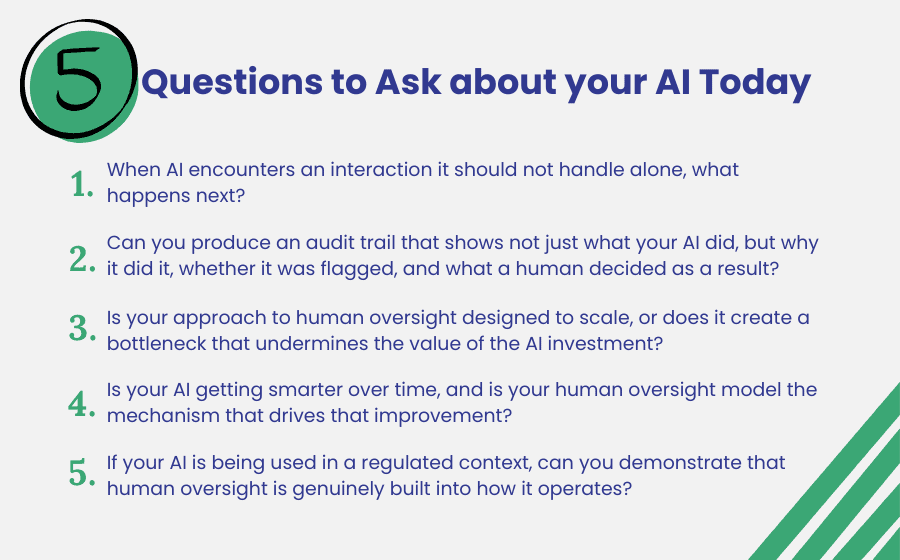
1. When AI encounters an interaction it should not handle alone, what happens next?
Not every interaction is straightforward and conversations can shift quickly when customer sentiment changes, complexity increases, or regulatory and financial risk surfaces. The question is whether your architecture has a deliberate, structured path for those moments. How are those interactions identified and flagged in the first place? And when something is flagged, does a human take over the entire conversation removing the AI from interactions where it could still be contributing safely, or is there a more nuanced model where human judgment is applied precisely where it is needed without abandoning the efficiency the AI was deployed to deliver? Is that process intentional, consistently applied, and documented, or is oversight manual and burdensome, limited to sampled reviews rather than consistent evaluation, and happening after the fact rather than in real time before a response ever reaches the customer?
2. Can you produce an audit trail that shows not just what your AI did, but why it did it, whether it was flagged, and what a human decided as a result?
As regulators and legislators begin to scrutinize AI deployments more closely, the ability to explain and document AI behavior is becoming as important as the behavior itself. An audit trail that only shows what the AI generated is no longer sufficient in a regulated environment. The question is whether your system captures the full picture, the reasoning behind the AI’s response, the risk signals that triggered a flag, the human decision that followed, and the outcome. Without that level of documentation, demonstrating compliance becomes difficult, defending a decision becomes harder, and identifying where your AI needs improvement becomes largely guesswork.
3. Is your approach to human oversight designed to scale, or does it create a bottleneck that undermines the value of the AI investment?
One of the most common failures in traditional human in the loop models is that they become unsustainable over time. If every AI-generated response requires human involvement, the efficiency gains that justified the AI investment to begin with disappear quickly. Queues build, response times climb, and the human reviewers who were meant to be a safeguard become a constraint on the entire operation. The question worth asking is whether your model is designed so that humans are seeing only what genuinely requires their judgment, or whether oversight has become a blanket process that treats every interaction the same regardless of risk or complexity. A well designed hybrid agentic AI model should allow a single reviewer to monitor multiple AI-led interactions simultaneously, stepping in only where their judgment is needed and nowhere else.
4. Is your AI getting smarter over time, and is your human oversight model the mechanism that drives that improvement?
One of the most under-appreciated aspects of a well designed human and AI collaboration model is what happens after a human makes a decision. Every approval, edit, escalation, or rejection is a signal, a data point that tells you something about where your AI is performing well, where it needs refinement, and what kinds of interactions it is not yet equipped to handle confidently on its own. The question is whether your system is designed to capture and learn from those signals, or whether the human review layer operates in isolation, disconnected from the AI’s ongoing development. Organizations that treat human oversight purely as a compliance mechanism miss the compounding improvement opportunity it represents. Over time, a well designed feedback loop should increase the proportion of interactions the AI can handle safely and autonomously, raising the bar on what it means for something to genuinely require human judgment.
5. If your AI is being used in a regulated context, can you demonstrate that human oversight is genuinely built into how it operates?
For organizations operating in or serving European markets, this question has a hard deadline attached to it. Article 14 of the EU AI Act, which becomes enforceable on August 2, 2026, requires that high-risk AI systems be designed in a way that allows humans to understand, intervene on, override, and interrupt them. It requires structured escalation paths, documented decision making, and audit evidence that human oversight actually happened. For US-based regulated businesses, even those without direct European exposure, the EU AI Act is increasingly being treated as a blueprint for where domestic regulatory expectations are heading, and many are already building their AI architecture to meet its standard. The question is not just whether you are aware of these requirements, but whether your AI architecture is genuinely designed to meet them, and whether you can prove it.
The organizations that will lead are not waiting for the perfect model or the perfect moment. They are making deliberate architecture decisions now, building human oversight in from the start, and recognizing that getting that architecture right is not just about managing risk. It is what unlocks the full efficiency potential of agentic AI, automating confidently where it is safe to do so, and reserving human judgment for the moments that genuinely require it. And for organizations that are still cautious about AI, the hybrid agentic model offers a practical and confidence-building path forward, one that allows you to start, progress at your own pace, and scale automation as trust in the system grows. The questions above are a starting point. How you answer them will tell you a great deal about where you stand and what needs to change.
Next in this series: The EU AI Act’s Article 14 human oversight requirements become enforceable in August. What regulated businesses need to know, and what it means for how your AI is built and governed.
Part of the Hybrid Agentic AI series by ServisBOT – helping regulated businesses deploy AI with confidence, compliance, and control.