
Agentic, AI, Voice
AI, Trust, and the Future of Mortgage Servicing
Between competitive pressure, rising borrower expectations, and the efficiency it delivers, adopting AI stopped being optional for mortgage servicers a while ago. How they do it is still theirs to control.
This stands to reason as they operate in a regulated environment where trust, once lost, is hard to rebuild. In deploying AI, the how matters just as much as the what. Call volumes, regulatory scrutiny, and economic uncertainty are all pushing servicers toward greater efficiency. But chasing efficiency can’t come at the cost of empathy in this industry, and that’s exactly where most automation has come up short for servicers before.
Traditional automation could handle scripted, predictable interactions, but broke down the moment a borrower’s situation got complicated.Generative AI changes this. It understands context, nuance, emotion and intent, and can reason across the unstructured data that servicers generate every day (call transcripts, notes, documents, emails) turning it into something usable in real time.
That capability shift is why the conversation in mortgage servicing has moved on. The question is no longer whether to adopt AI. It’s how to do it with the oversight, auditability, and compliance safeguards this industry demands.
Why AI is an Ideal Fit for Mortgage Servicing
When you think of mortgage servicing consider the operational environment of:
- Unstructured data no one has time to analyze
- Quality assurance that only ever touches a small sample of interactions
- Regulatory risk that goes undetected until it’s already a problem
- Portfolio risk buried in data too vast to review manually
This is why AI belongs – because the things that make servicing hard can now be addressed so well by AI. Here are 3 simple examples:
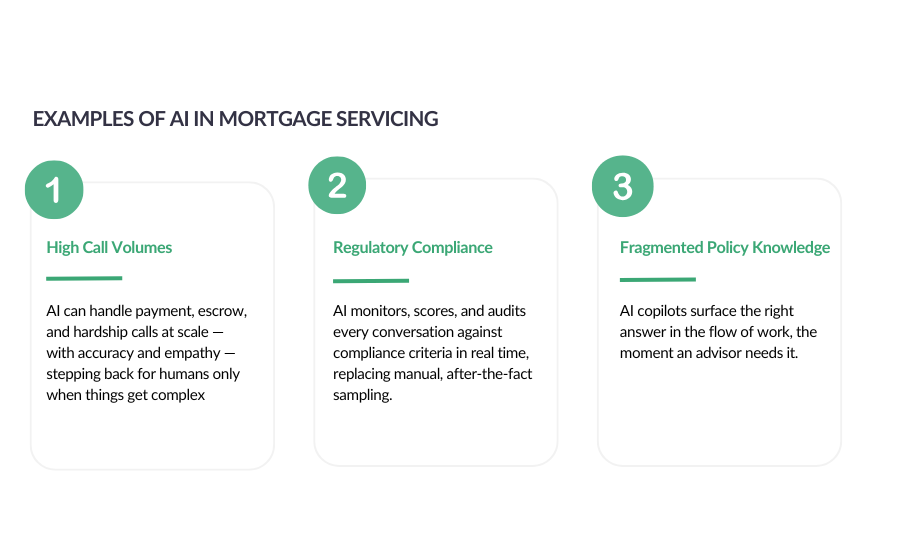
Three High Value Use Cases for AI
Not all AI use cases carry equal weight, and some are proving especially transformative for servicers who’ve moved past the pilot stage.
- Voice AI is bringing precision at scale to every call. Borrowers still overwhelmingly want to pick up the phone when they’re navigating a payment issue or a hardship situation, and legacy IVR systems have never been equipped to meet them there with anything resembling real understanding. Modern Voice AI combines speech recognition, language understanding, and real-time sentiment analysis to know the difference between a routine payoff request and a borrower in distress and to escalate accordingly.
- Human and AI Collaboration is solving the oversight problem. The old choice was binary: automate for efficiency, or review manually for control. Risk-based supervision breaks that trade-off and goes beyond mere human-in-the-loop (HITL) escalation paths. Here a human can monitor, review, approve, or edit an AI response without stepping into the conversation directly, then hand it back to the AI to close out. Full takeover is still available; it just isn’t the only option. The AI keeps doing the work, and human judgment gets exercised at the point of output rather than by displacing the AI entirely. That’s the difference between AI that scales and AI that’s actually trusted to scale.
- Customer Intelligence is turning a data problem into a strategic advantage. Servicers have always sat on an enormous amount of borrower intelligence (call histories, payment patterns, loss mitigation records) that was simply too vast and too unstructured to analyze systematically. AI that continuously mines that data for early risk signals, life events, and compliance trends doesn’t just catch problems faster. It shifts servicing from reactive to proactive, which is exactly where the industry needs to be heading.
None of this works if it’s bolted on as an afterthought. Deploying AI in a mortgage organization isn’t purely a technology decision. It’s a trust decision. Data privacy, hallucination prevention, compliance-by-design, and human oversight at the moments that matter most all have to be engineered into the platform from day one, not patched in after something goes wrong.
Delve Deeper with our new EBook
We’ve put together a full breakdown of the highest-value AI use cases for US mortgage servicers, grounded in our real-world experience. These cover everything from voice AI and agent assist to compliance monitoring, proactive borrower engagement, with a nod to where the technology is headed over the next year or two.
Download the eBook: High-Value AI Use Cases for Mortgage Servicers →
If you want to see how this looks like in practice for your servicing operation, request a demo and we’ll walk you through it.